
Drought Conditions in Thornton and What We Can Do
Monitoring Drought Conditions
*Updated May 14, 2026.
The city of Thornton has declared a Stage 1 Drought response, effective March 15, to reduce water demand while water supplies are projected to be lower than normal. Thornton depends on snowpack in the Rocky Mountains for its annual water supply and this winter has been unusually dry and warm. We are seeing some of the lowest snowpack levels in the state’s history and like many neighboring water providers, Thornton is monitoring drought conditions closely and taking steps to conserve resources.
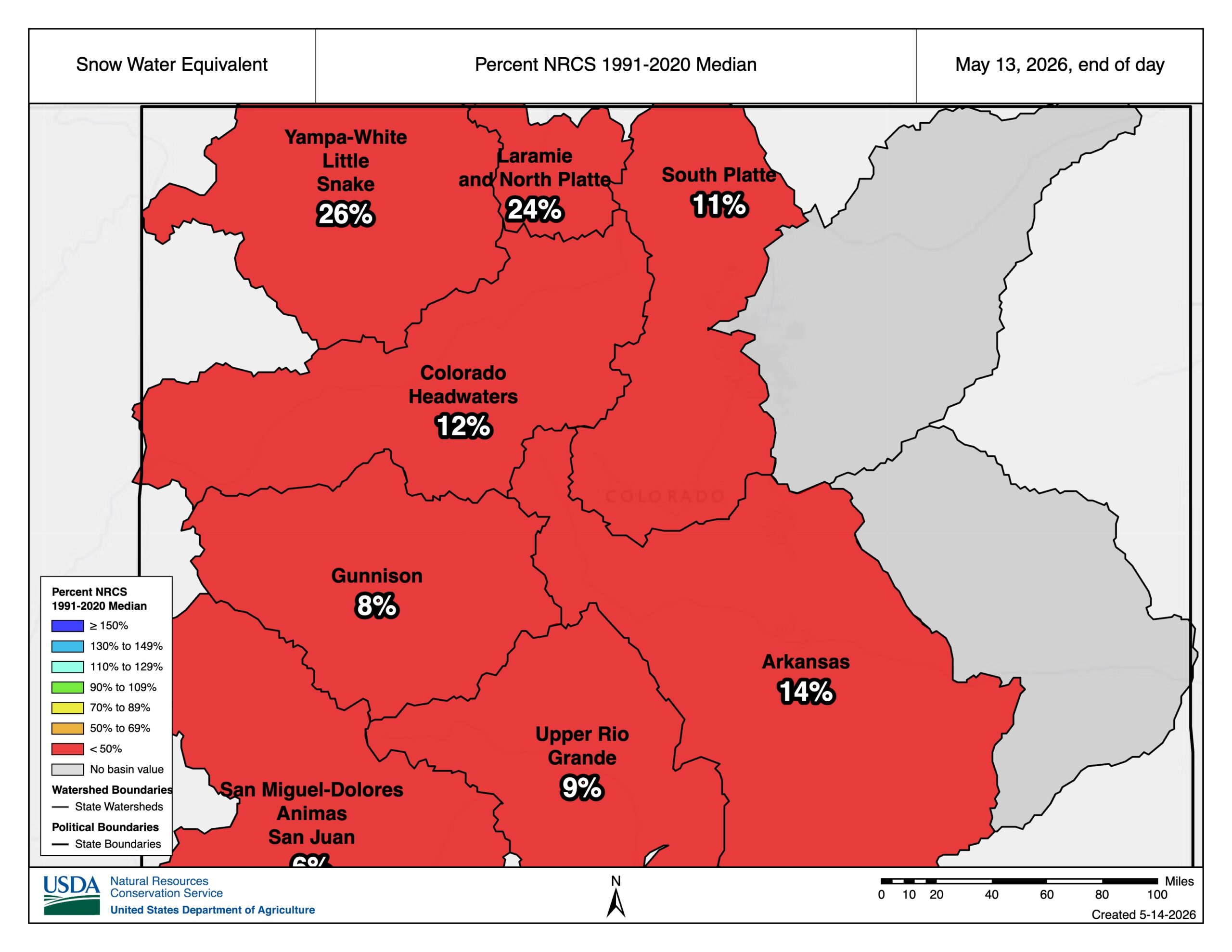
In Colorado, a significant portion of our fall, winter, and even spring precipitation typically falls as snow, especially at higher elevations. As of March 15, 2026, snowpack levels across the state are currently between 48 and 72 percent of the 30-year median, indicating a significant lack of moisture. (*As of May 14, 2026, snowpack has decreased to between 6 and 26 percent of the 30-year median). This type of drought is referred to as “snow drought,” which may come from warmer-than-average temperatures in areas where snow is typically the main form of precipitation.
Below are some tools Thornton uses to monitor and manage drought, and what water customers can do during drought to help conserve water supplies.
US Drought Monitor
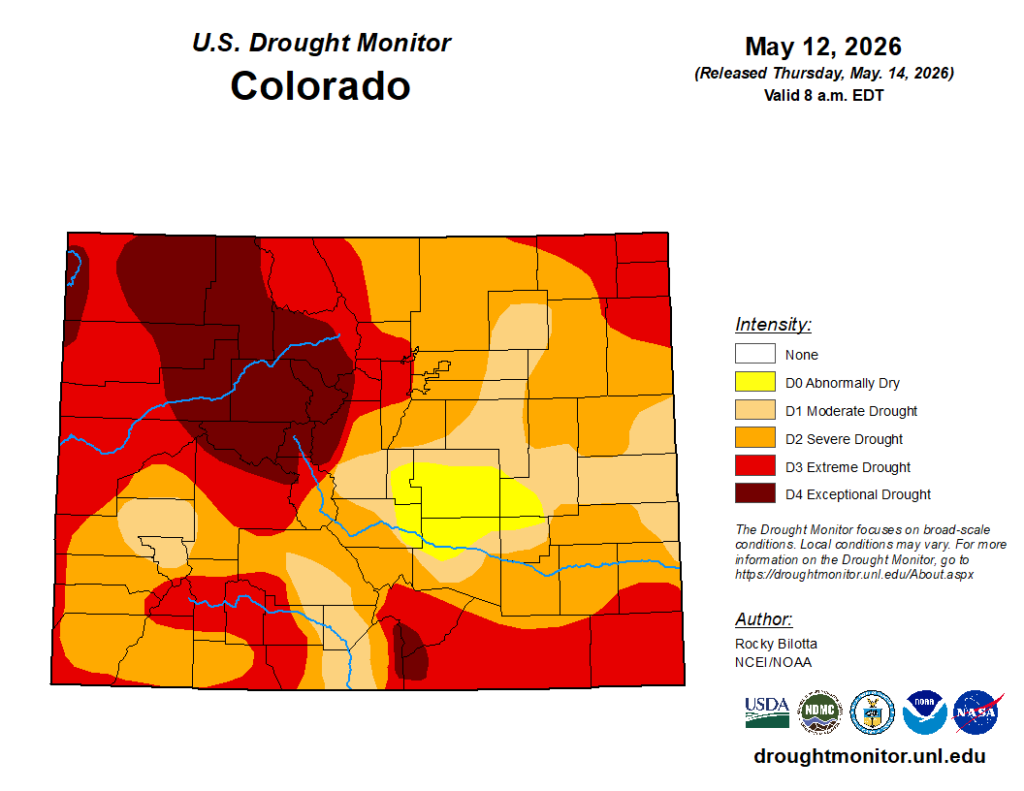
One trusted source of information is the U.S. Drought Monitor portal, provided through a partnership between the National Drought Mitigation Center, the United States Department of Agriculture, the National Oceanic and Atmospheric Administration, and the National Aeronautics and Space Administration. As of May 14, the U.S. Drought Monitor reports that 100% of Colorado is experiencing abnormally dry to exceptional drought conditions.
To access the latest drought monitor map, visit the Colorado state drought monitor page.
NRCS Snow Water Equivalent Map
The Natural Resources Conservation Service (NRCS) and the National Water and Climate Center (NWCC) provide technical data and forecasts for snowmelt-driven water supply. This tool allows users to view the Snow Water Equivalent (SWE) in each watershed in the State, including the South Platte Basin that supplies all of Thornton’s water. In addition to snow water equivalent, Thornton factors in streamflow predictions, reservoir storage levels and customer demands to manage drought. Thornton projects reservoir storage levels out 18 months into the future using a model that takes into account our water rights, weather conditions, customer demands and many other factors.
Access the latest NRCS Snow Water Equivalent map here.
How does drought impact the availability of Thornton’s water?
Thornton maintains a large and diverse portfolio of water rights, including water from the Clear Creek, South Platte, and Cache la Poudre Rivers. Thornton’s water is diverted from the river and stored in reservoirs before it is treated at the Wes Brown and Thornton Water treatment plants. This process of delivering our water through rivers, headgates, ditches, reservoirs, and treatment facilities turns spring and summer snowmelt from our mountains into clean, high-quality treated water delivered straight to your tap.
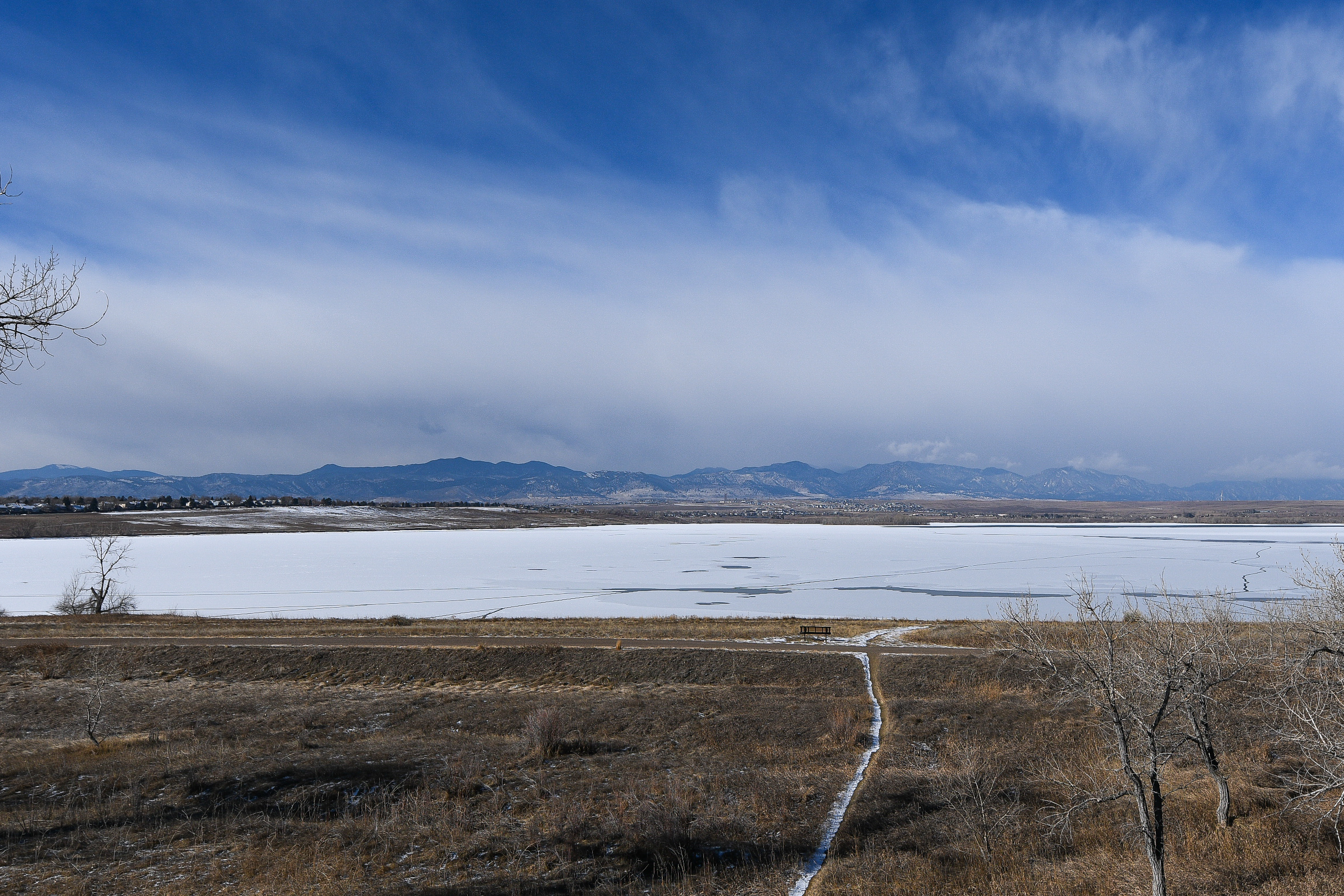
A lower-than-average snowpack leads to lower stream flows, resulting in a lower-than-average volume of water delivered to Thornton’s reservoirs. To make matters worse, when it is hot and dry on the Front Range, customer water demand increases. Higher water demand and lower supply in our reservoirs can significantly impact the overall water supply for Thornton customers.
To manage the balance of water supply and demand during drought, Thornton Water staff looks to the Drought Management Plan to guide us in managing water supplies and water demands to ensure resiliency for our customers. Just as in previous years when Thornton enacted watering restrictions, including 2002-2003, 2006, and 2012-2013, Thornton is working hard to mitigate potential risks associated with drought.
How does Thornton Prioritize Water Use During Drought?
During drought years, Thornton can experience water shortages, requiring the community to reduce water use based on a tiered priority structure:
- Health and safety: All indoor sanitary uses, including indoor residential, health services, schools, businesses, etc. This also includes firefighting and hydrant flushing.
- Community vitality: Non-sanitary indoor uses and outdoor uses for business and commercial purposes including water for construction, commercial car washes, golf course(s), and indoor pools.
- Established trees: Established trees throughout the city including trees in parks, residential neighborhoods, commercial centers, etc.
- High priority outdoor use: Trees/shrubs, parks, sports fields, school fields, outdoor public pools, and vegetable gardens.
- Low priority outdoor use: HOA common areas, established turf grass throughout the community, private pools, water features.
These priorities are established as part of Thornton’s Drought Management Plan, and are designed to maintain the health, safety, and vitality of the community while also preserving overall quality of life to the maximum extent possible. During Stage 1 Drought, Thornton expects to meet all of the water use priorities, with a goal of 10% savings throughout the water service area.
How is the city saving water?
As a community, we are in this together. The city will be working hard to:
- Reduce parks watering by 10%: Key high-use areas will still be watered, including all sports fields, high-traffic areas, and the Thorncreek golf course. Parks will irrigate other passive-use areas less to meet water savings, including low-traffic areas and detention ponds.
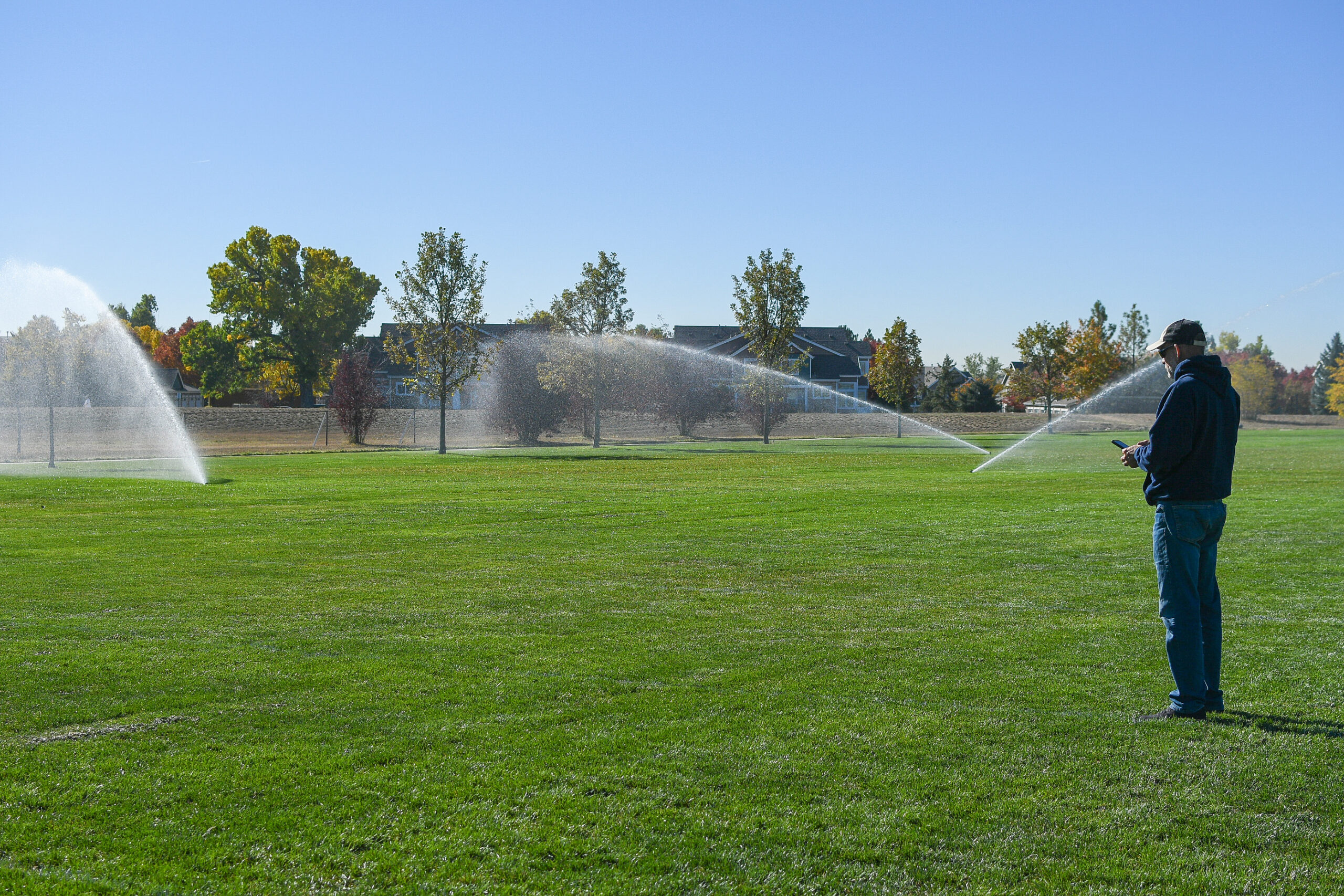
- Performing regular sprinkler checks: Parks staff will perform regular sprinkler system checks to identify leaks and ensure all sprinkler components are working properly and efficiently.
- Maintaining turf area health through fertilization, aeration, and other landscape management best practices.
- Using Advanced Metering Infrastructure (AMI) data to find leaks and fix them quickly.
- Using non-potable water to irrigate parks when possible.
- Maximizing Thornton’s water rights portfolio to bring water into our reservoirs.


How can I help Thornton save water?
Regardless of drought, Thornton always has permanent watering rules that prohibit watering between 10 a.m. and 6 p.m. and limit irrigating to 3 days per week. During Stage 1 Drought, customers may only water 2 days per week. You can do your part by following the city of Thornton Stage 1 Drought Rules and Regulations below.
- Wait to Water until May. Thornton is asking all customers to wait to water lawns until May. Kentucky Bluegrass is dormant now, and even though it looks brown and dry, the roots are alive under the soil. Bringing lawns out of dormancy too early is unnecessary and will use more water. Waiting to water will support Thornton’s water-saving goals and help decrease unnecessary early demands on our reservoirs and water treatment systems.
- When lawn watering begins in May, set your irrigation system to water no more than 2 days per week. Kentucky Bluegrass lawns can survive and even thrive with 2 days of watering per week. Not only does less frequent watering save water, but it also strengthens and deepens lawn roots, making your lawn more drought tolerant.
- No lawn irrigation between 10 a.m. and 6 p.m.
- Note: You may see watering in parks during the day. Staff will be running regular water efficiency system checks and identifying priority areas that require higher quality turf management, overseeding, or recovery from high traffic. These exemptions allow for water efficiency and safety on Thornton’s many recreational sports and festival areas.
- Hand watering, drip irrigation, and deep root watering is allowed and encouraged for trees, shrubs and gardens.
- Wait until Mother’s Day in May to plant vegetable gardens. Freezes can occur up until then and can damage young plants.
- CSU Extension recommends watering vegetable gardens every other day in the heat of the summer.
- The tree canopy is a critical element for our community and helps cool the environment, creating a livable, healthy city.
Maximize Water Efficiency with Rebates and Services for Thornton Water Customers
Thornton Water offers multiple residential, commercial and HOA/multifamily rebate programs and services to help you manage and convert your landscape and save water over the long-term:
- Track your water usage with WaterSmart. See how your use compares to last year and catch leaks before they cause high bills and water waste. If Watersmart identifies a leak, you can use our Finding and Fixing Leaks Checklist to locate and repair your leak.
- Sign up for Residential rebates for irrigation controllers, rain sensors, and toilets. Prepare for the irrigation season and improve the efficiency of your internal water fixtures with helpful and practical rebate offerings for WaterSense-labeled products.
- Explore HOA & Multifamily and Commercial rebates and services for irrigation and building water efficiency projects, landscape grants, water-wise efficiency assessments, and toilet rebates.
- Sign up for Resource Central’s Lawn Replacement Program: Thornton Water customers can receive up to $750 toward discounted lawn removal services or water-wise plants to help save water and transform your yard into a beautiful water-wise garden.
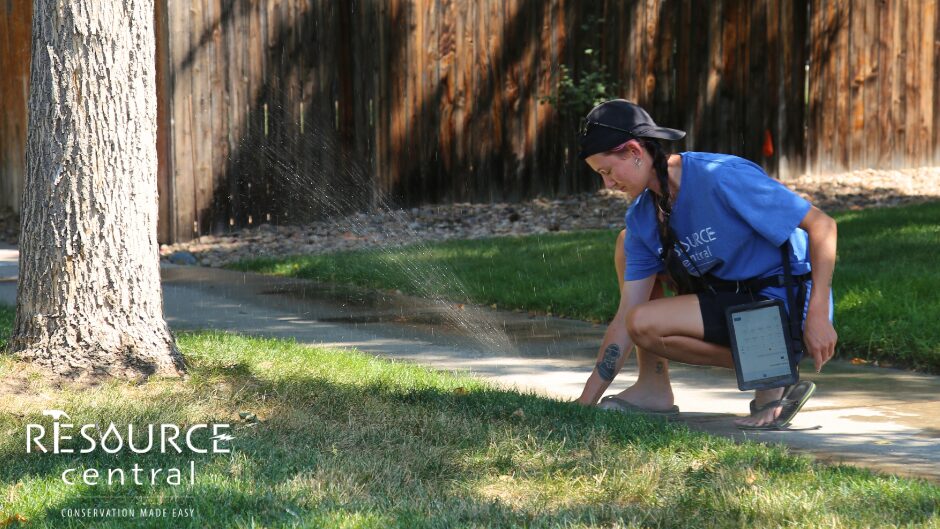
- Register for a residential sprinkler evaluation or commercial sprinkler evaluation* with Resource Central. During this free consultation, your sprinkler technician will help you identify water waste, calibrate your sprinkler heads, and set up a custom watering plan to balance the health of your landscape with water-wise best practices. You can join the interest list now – appointments are scheduled on a first-come, first-served basis.
- Transform your garden with Garden In A Box kits through Resource Central. Choose from a variety of professionally designed low-water garden kits to fit your needs. Thornton Water customers can receive $25 off full box sets each season while supplies last.
- Access free water-wise landscape webinars year-round through Resource Central. Learn more about trees, pollinators, design, plant selection, and more!
*includes HOA/multifamily properties
Drought Resources
For real-time updates on drought conditions in Thornton, current rules and restrictions, and more information on how Thornton prepares for drought conditions, visit the Restrictions and Drought page. For a detailed report on Thornton’s overall approach to drought, review the Thornton Drought Management Plan.
For updates and developments across the state, visit the Western Water Assessment Intermountain West Dashboard.
Questions? Contact us at Water@ThorntonWater.com or 720-977-6600. For questions about your bill, visit goCOT.net/utilitybilling, contact UtilBilling@thorntonco.gov or call 303-538-7370.